
Creators are building businesses beyond sponsorships
The next stage of the creator economy isn't simply earning more sponsorships. It's creators using their audiences to build businesses they actually own.
For years, one of the clearest signs that somebody had successfully become a creator was relatively simple: brands started paying them.
Build an audience, accumulate enough followers, attract companies that wanted access to those followers, negotiate a fee, publish sponsored content and repeat the process for as long as advertisers remained interested.
Sponsorships turned attention into income.
But they also created a peculiar type of business in which the creator could have millions of followers, employ a team, generate enormous cultural influence and still depend heavily on somebody else's marketing department deciding to send them another campaign brief.
That is beginning to change.
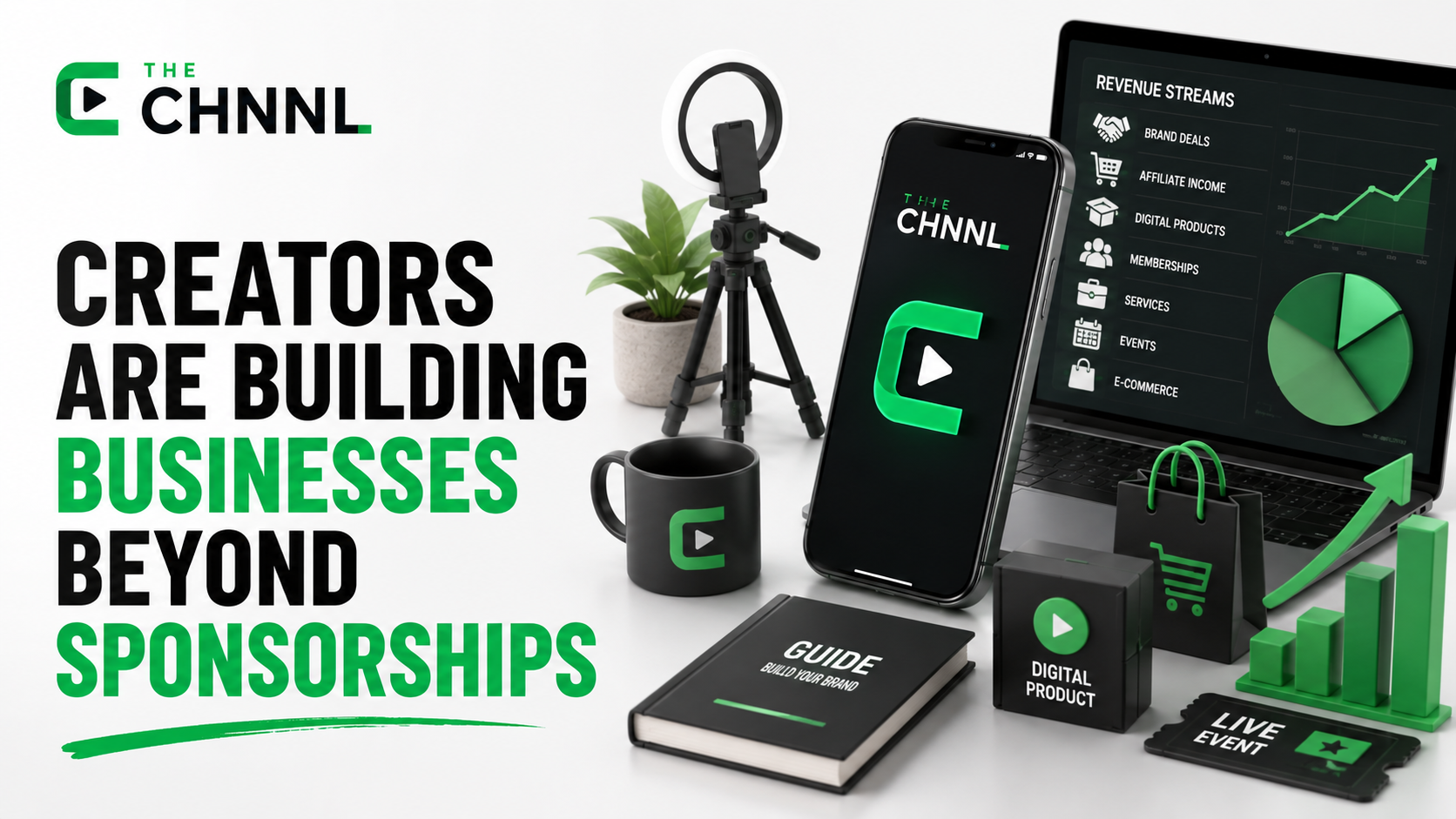
Creators are increasingly adding affiliate commissions, subscriptions, memberships, digital products, physical products, events, services, licensing, ecommerce and even equity investments alongside traditional sponsorship income, gradually transforming the creator career from a succession of advertising campaigns into something that looks much more like an actual company.
And the distinction matters.
Because there is a significant difference between making money as a creator and building a creator business.
Sponsorships are valuable, but they are unpredictable
There is nothing inherently wrong with sponsorships.
They remain one of the most important sources of creator income and can be extremely lucrative, particularly for creators with large or commercially attractive audiences.
Later's 2026 research found that 82% of creators expect brand deals to be a top revenue stream, demonstrating just how central partnerships remain to the economics of professional content creation.
But sponsorships have a structural weakness.
The creator does not completely control them.
A company can reduce its influencer budget.
A marketing director can change strategy.
An agency can choose another creator.
A campaign can be cancelled.
A creator's category can fall out of fashion.
An economic downturn can make advertisers more cautious.
Or the creator can simply experience a quiet month in which the opportunities do not arrive.
CreatorIQ's 2026 research demonstrates how significant this problem remains: 67% of the more than 5,000 creators it surveyed earned less than $10,000 annually from content creation, while 62% said content creation was not their primary source of income.
CreatorIQ also found that the number-one barrier creators identified to growing their businesses was a lack of consistent brand deals.
That tells us something important.
Creators are not necessarily moving beyond sponsorships because sponsorships have stopped working.
They are doing it partly because sponsorships do not always arrive reliably enough to build a stable company around them.
The creator business starts when the audience becomes an asset
The most important thing a successful creator builds is not actually content.
It is trust and distribution.
A beauty creator might have 200,000 people who regularly listen to their product recommendations.
A fitness creator might have 50,000 people interested in improving their health.
A parenting creator might have an audience of mothers and fathers facing similar problems.
A gaming creator might have an intensely engaged community built around a particular game.
Those audiences are economically valuable because the creator already possesses something most businesses spend enormous amounts of money trying to acquire:
Attention from a clearly defined group of people.
Sponsorships allow another company to temporarily access that attention.
Building a creator business allows the creator to begin commercialising it themselves.
That is the fundamental shift.
Instead of asking:
“Which brand will pay me to speak to my audience?”
the creator can increasingly ask:
“What can I build for my audience?”
Affiliate commerce creates revenue without waiting for a campaign
Affiliate marketing is one of the easiest ways for creators to make that transition.
The creator does not necessarily need a company to offer them a £5,000 campaign.
They can recommend products and earn a percentage when their content generates purchases.
Social commerce is making this model considerably more powerful.
TikTok Shop allows creators to attach products directly to videos and LIVE broadcasts, while YouTube continues expanding its Shopping Affiliate Program and has recently brought Amazon products into its US programme.
Meanwhile, companies are raising substantial amounts of money to build the infrastructure surrounding creator affiliate commerce.
Levanta recently raised $22 million after building a network of more than 90,000 vetted creators who can promote products sold through Amazon, Walmart and Shopify, with the company handling infrastructure including attribution, creator payments and tax administration.
Later's research found that 54% of creators want to expand their income through affiliate channels.
The appeal is understandable.
Sponsorship revenue requires another company to choose the creator.
Affiliate revenue gives the creator more ability to choose the commercial opportunity themselves.
Creators are also becoming product companies
The next step is considerably more ambitious.
Instead of receiving a percentage for selling somebody else's product, creators can build their own.
This is where the economics of the creator business potentially change dramatically.
A creator promoting somebody else's skincare product might receive a sponsorship fee or affiliate commission.
A creator who owns the skincare company participates in the value of the entire business.
CreatorIQ found that 50% of creators surveyed have either launched their own brand or plan to launch one, an extraordinary figure that demonstrates how widespread creator entrepreneurship is becoming.
This does not mean half of creators will successfully build consumer companies.
Manufacturing is difficult.
Inventory is expensive.
Customer service is difficult.
Logistics are difficult.
Retail is difficult.
Running a company is fundamentally different from running a social account.
But creators possess an unusual advantage when they attempt it.
They can begin with distribution.
A conventional entrepreneur might develop a product and then spend enormous amounts of money trying to find customers.
A creator can potentially develop a product alongside an audience that already trusts them.
That reverses part of the traditional startup process.
Audience first. Product second.
Digital products offer an even simpler route into ownership
Not every creator needs to manufacture something physical.
For creators whose value comes from knowledge or expertise, digital products can provide another route towards owned revenue.
Courses.
Templates.
Guides.
Ebooks.
Presets.
Research.
Educational programmes.
Software.
Paid newsletters.
Digital downloads.
The attraction is obvious.
Once created, a digital product can often be sold repeatedly without the inventory, warehousing and fulfilment costs associated with physical products.
A creator who knows exactly what their audience repeatedly asks for can turn those questions into products.
The relationship changes again.
Instead of a brand paying the creator for access to their audience, the audience becomes the customer.
Services turn creator expertise into another company
Some creators are discovering that the skills they developed while building audiences are themselves commercially valuable.
A creator who has spent five years learning short-form video understands something many companies desperately want to understand.
They know how to identify ideas.
Write hooks.
Film efficiently.
Edit for retention.
Understand platform culture.
Interpret analytics.
Build communities.
And communicate in a way that does not immediately feel like corporate advertising.
Those skills can become services.
Consulting.
Creative direction.
Content production.
Social strategy.
Workshops.
Speaking.
UGC production.
Training.
Forbes recently highlighted creators expanding into areas including digital services, events, speaking, publishing and other professional opportunities precisely because creator skills can be monetised outside the conventional sponsored post relationship.
A creator can therefore gradually become an agency, consultant or professional-services business without abandoning their public content.
Their audience becomes proof that they know what they are doing.
UGC has separated content creation from audience ownership
The growth of user-generated-content work introduces another interesting business model because creators do not necessarily need to provide distribution at all.
A company might simply pay them to produce the content.
The brand then publishes or advertises it.
Later found that 42% of creators are interested in expanding into UGC licensing, demonstrating how creator monetisation is broadening beyond conventional influencer campaigns.
This is a subtle but important change.
Traditional influencer marketing bundles two assets together:
Creative ability + audience.
UGC can separate them.
A creator with exceptional video skills but only 3,000 followers can still be commercially valuable because a brand might want the video rather than the audience.
That creates another pathway into the creator economy for people who may never become large influencers.
Memberships turn followers into recurring customers
Another attractive model is recurring revenue.
One off sponsorships create one off payments.
Memberships and subscriptions can potentially create income every month.
A creator with an intensely loyal audience might offer:
Exclusive content.
Private communities.
Educational resources.
Behind the scenes access.
Premium newsletters.
Member events.
Group calls.
Early access.
Or specialist research.
The audience does not need to be enormous.
Imagine a specialist creator with 20,000 highly engaged followers.
If 500 people are willing to pay £10 per month for something genuinely valuable, that represents:
£5,000 in monthly recurring revenue.
That is a very different business from hoping another £5,000 sponsorship arrives next month.
The creator has converted part of their audience into customers.
Events move creator communities into the physical world
Creator businesses are also moving offline.
Fitness classes.
Conferences.
Meet ups.
Tours.
Workshops.
Pop ups.
Retreats.
Live shows.
Forbes highlighted fitness creator Jacklyn Romano, who built in-person community events from her online following and said those events had become a significant and rapidly growing portion of her income, reducing her dependence on brand deals. Forbes
This is another reminder that the creator economy is no longer confined to social media.
Social platforms can simply be the customer-acquisition layer.
The actual business can exist somewhere else entirely.
Some creators are moving from promoting companies to owning pieces of them
There is an even more sophisticated evolution happening at the top of the market.
Creators are becoming investors.
Rather than receiving only cash to promote a company, some creators are taking equity positions in businesses they believe they can help grow.
Alix Earle, Sofia Richie Grainge and Hannah Bronfman are among the creators increasingly associated with this influencer-investor model, where creators can combine capital, distribution and marketing influence with ownership.
The logic is powerful.
Imagine a creator receives £100,000 to promote a company.
They publish.
The campaign succeeds.
The company becomes substantially more valuable.
The creator receives their £100,000.
The shareholders receive the long-term upside.
Equity asks a different question:
If my influence is helping create enterprise value, should I own some of that value?
It is a considerably riskier proposition because private companies can fail and equity can ultimately be worth nothing.
But conceptually, it represents perhaps the furthest evolution from sponsorship.
The creator moves from being paid by the business to becoming part of the business.
Diversification is partly about independence
There is a common thread connecting all these models.
Control.
A sponsorship depends on a brand.
Platform advertising revenue depends on a platform.
Algorithmic distribution depends on a platform.
A creator business will always have dependencies, but diversification reduces the possibility that one company or revenue stream can determine whether the creator survives.
A creator might eventually have:
- Brand partnerships generating 30% of income.
- Affiliate commissions generating 20%.
- Their own products generating 25%.
- Memberships generating 10%.
- Consulting generating 10%.
- Events generating 5%.
If sponsorship revenue suddenly falls by half, that is painful.
It is not necessarily catastrophic.
That is what diversification can provide.
Not simply more money.
Resilience.
This is also why creators are beginning to look like small businesses
Visa's research provides perhaps the clearest indication of how creators increasingly view themselves.
Its creator research found that 68% of surveyed creators globally considered themselves small-business owners, while 88% expected their businesses to grow during the following year.
Among UK creators specifically, Visa reported that 73% viewed their work as a small business, while 54% identified themselves as successful business owners.
That language matters.
Not influencer.
Not internet personality.
Not social media star.
Business owner.
And once creators begin thinking that way, their decisions naturally change.
The creator suddenly has the same problems as every other entrepreneur
The glamorous part of the creator economy is visible.
Videos.
Followers.
Events.
Products.
Campaigns.
The less glamorous part begins when the creator becomes a company.
Accounting.
Contracts.
Tax.
Payroll.
Insurance.
Inventory.
Customer service.
Cash flow.
Legal compliance.
Hiring.
Management.
Visa found that 86% of creators it surveyed were using personal funds, savings or credit cards to finance their creator work, while 26% said they needed help with areas including financial management, contract negotiation and tax or legal compliance.
Those are not creator problems.
They are small-business problems.
And their appearance is evidence that the creator economy is maturing.
The strongest creator businesses will own more of their relationship with audiences
There is another layer to this transition that could become increasingly important.
Ownership of distribution.
A creator can have two million TikTok followers and still be dependent on TikTok deciding whether their next video deserves distribution.
They do not own those two million accounts.
The platform controls the relationship.
Creators building businesses therefore have a strong incentive to move some of that relationship into infrastructure they control more directly.
Email lists.
Customer databases.
Membership communities.
Websites.
Apps.
Subscriptions.
Direct purchasing relationships.
The objective is not necessarily to leave social media.
Social platforms remain extraordinarily powerful discovery engines.
The objective is to use social platforms to build assets beyond social platforms.
That is one of the biggest differences between an influencer and a creator entrepreneur.
This changes what success in the creator economy looks like
The creator economy has historically celebrated visible metrics.
One million followers.
Ten million views.
A viral video.
A celebrity collaboration.
Those achievements still matter.
But some of the most commercially successful creators of the next decade may look surprisingly unimpressive according to those measurements.
Someone might have 150,000 followers and operate a £2 million ecommerce company.
Another might have 30,000 followers and sell £300,000 worth of educational products.
Another might run a membership business producing £20,000 of recurring monthly revenue.
Another might operate an agency behind their personal brand.
Another might build a portfolio of equity investments.
Another might become an exceptional TikTok Shop affiliate.
Another might run sold-out events.
Their follower count tells us very little about the company underneath it.
And that is the important shift.
Sponsorships are becoming one line on the creator P&L
Sponsorships are not disappearing.
If anything, brands are investing more heavily in creators.
CreatorIQ estimated the global creator marketing market reached $32.6 billion in 2025, while aggregate creator compensation increased substantially, even though those payments remained heavily concentrated among top earners.
But the creator industry's maturation means sponsorship income increasingly sits alongside other revenue rather than defining the entire business.
The professional creator might have advertising income.
Affiliate income.
Product income.
Subscription income.
Licensing income.
Service income.
Investment income.
And sponsorship income.
At that point, the word influencer begins to feel inadequate.
They are entrepreneurs who happen to possess an unusually powerful distribution channel:
themselves.
The creator is becoming the starting point, not the finished product
This may ultimately be the most important way to understand the next stage of the creator economy.
Building an audience used to feel like the destination.
Get enough followers.
Become a successful creator.
Secure sponsorships.
Make a living.
Increasingly, building the audience can be the beginning.
The audience creates distribution.
Distribution creates trust.
Trust creates transactions.
Transactions create revenue.
Revenue creates the opportunity to build products, services, teams and eventually companies.
The creator therefore becomes the customer-acquisition engine underneath something considerably larger than a social media account.
And the creators who understand that distinction may ultimately build the most durable businesses.
Because sponsorships allow creators to monetise somebody else's company.
Creator entrepreneurship allows them to build their own.
Related stories
Influencers Are Starting to Become Investors in the Brands They Promote
The creator economy is moving from promotion towards ownership, as influencers increasingly invest in the brands their audiences can help grow.
TikTok Shop is changing what it means to be a creator
TikTok Shop is turning creators from attention generators into participants in the transaction itself and changing what commercial influence looks like.
Why brands are starting to treat creators as sales channels
Creators are moving closer to the transaction, giving brands something more powerful than attention alone: a new way to sell products.