
What does a TikTok Shop creator actually earn?
TikTok Shop can generate serious creator income, but GMV, commission and actual earnings are three very different numbers.
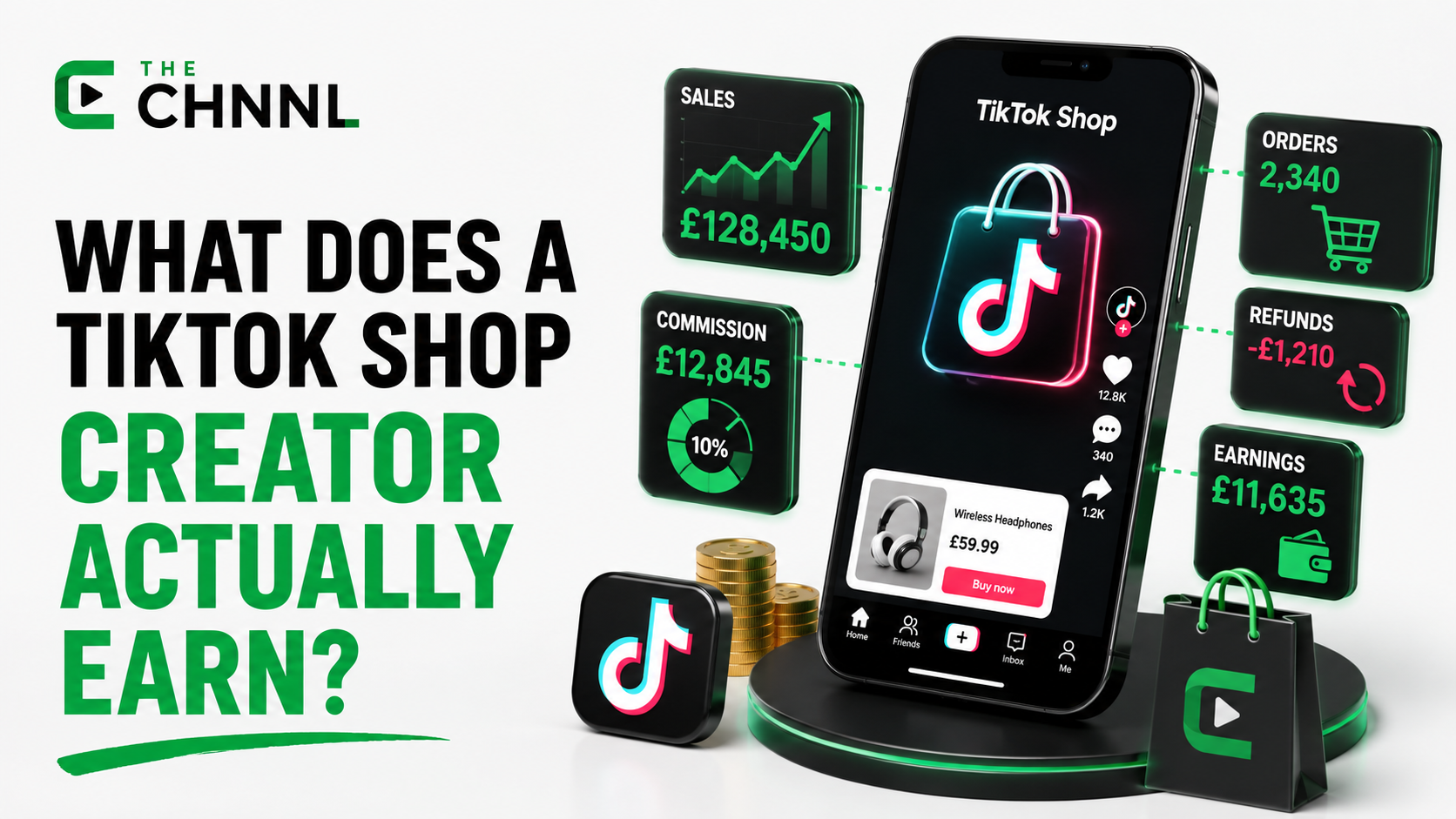
TikTok Shop has created some extraordinary numbers around the creator economy, with screenshots showing creators generating enormous amounts of GMV, stories of individual videos producing thousands of pounds in commission and increasingly sophisticated agencies recruiting people specifically because of their ability to sell products through short-form video and LIVE shopping.
But there is an important distinction that can easily disappear when discussing those numbers.
Sales are not earnings.
A creator might generate £100,000 of GMV without earning anything close to £100,000 themselves, because the creator generally receives a percentage of qualifying sales rather than the entire value of the products they help sell, while refunds, commission rates, product prices and the attribution of individual orders can all affect what eventually reaches their bank account.
So what does a TikTok Shop creator actually earn?
The answer can range from almost nothing to substantial sums of money, and understanding why requires looking beyond the screenshots and understanding how the creator-commerce model actually works.
First, understand what creators are being paid for
For an affiliate creator, the basic TikTok Shop proposition is relatively straightforward.
A seller lists a product on TikTok Shop and makes it available for creators to promote, either through an open collaboration that creators can discover themselves or through a targeted collaboration where particular creators are invited to participate.
The creator can then promote the product through shoppable videos, LIVE content or other eligible affiliate activity.
When their content generates a qualifying purchase, the creator receives a commission.
TikTok's UK guidance describes the calculation simply:
Commission = (Revenue − Refunds) × Commission Rate.
That means three numbers immediately matter.
How much product did the creator sell?
How much of that remained after refunds?
And what percentage commission did the seller offer?
This is why two creators generating exactly the same GMV can earn completely different amounts of money.
£100,000 in GMV does not mean £100,000 in earnings
Imagine a creator generates £100,000 worth of qualifying product revenue and, for simplicity, assume there are no refunds or other adjustments affecting the commission base.
If their commission rate is 5%, that represents roughly:
£5,000 commission.
At 10%:
£10,000 commission.
At 15%:
£15,000 commission.
At 20%:
£20,000 commission.
The difference is enormous.
And TikTok does not impose one universal affiliate commission rate across every product.
Sellers determine the commission available to creators, and different collaboration arrangements can offer different rates. TikTok's own UK Affiliate documentation gives an example where a product might offer 10% through an Open Collaboration but 15% to a creator invited through a Target Collaboration.
TikTok Shop Affiliate Partners can also run campaigns offering creators commission rates above those available through a seller's normal open plan.
The amount somebody sells is therefore only half the story.
What they earn per sale matters enormously.
Product economics change everything
Consider two creators who each sell 1,000 products.
Creator A promotes a £10 product offering 10% commission.
That is approximately £1 earned per qualifying sale, or around:
£1,000.
Creator B promotes a £50 product offering 20%.
That is approximately £10 per qualifying sale, or around:
£10,000.
Same number of units.
Ten times the commission.
This is why experienced commerce creators increasingly think differently about product selection.
A product might look extremely attractive because it is selling quickly across TikTok, but if its price and commission are low, enormous volume may be required before the creator earns meaningful money.
Another product might sell fewer units but generate considerably more commission per transaction.
The creator therefore starts making decisions that resemble those of a retailer or affiliate publisher.
Not simply:
Do I like this product?
But:
Can I sell it, and what is a successful sale actually worth to me?
GMV is useful, but it can create misleading impressions
This distinction becomes particularly important because GMV has become one of the headline numbers of TikTok Shop culture.
A creator might proudly announce that they generated £250,000 in GMV during a month.
That is commercially impressive.
It demonstrates that their content influenced a substantial amount of purchasing activity.
But it is not the same as saying:
“I made £250,000 this month.”
The majority of that money represents the value of the products purchased.
The seller receives the product revenue subject to the various costs and fees involved in fulfilling those transactions, while the creator receives the affiliate commission attached to eligible sales.
TikTok itself distinguishes between metrics such as Commission GMV, items sold, commission base and estimated commissions inside creator analytics.
That distinction is worth remembering whenever enormous TikTok Shop numbers appear on social media.
GMV measures economic activity.
Commission is much closer to creator income.
Even estimated commission is not necessarily what reaches the creator
There is another complication.
TikTok's Creator Centre can show estimated commissions, but the final amount can change.
TikTok explains that estimated commission is calculated using the product's average discounted price and its commission rate, while the eventual payout can differ because of factors including discounts, refunds and the final revenue associated with qualifying purchases.
Suppose a creator generates £10,000 of apparent sales at a 15% commission rate.
The obvious calculation produces £1,500.
But some customers return their products.
Others cancel.
Discounting affects the commission base.
Not every order ultimately becomes a settled qualifying transaction.
The final commission can therefore be lower than the number initially displayed.
TikTok's UK rules explicitly account for refunds in the commission formula.
That is another reason creator earnings should not be calculated simply by looking at the largest number visible on a Shop dashboard.
Creators also have to wait for the transaction to settle
TikTok Shop earnings are not necessarily available the moment somebody places an order.
The product needs to make its way through the purchasing and settlement process.
TikTok's current UK guidance says creators should generally receive commission on the third or fifteenth day after an order is successfully delivered, depending on the seller's settlement period, while disputes, returns and refund requests can delay the process further.
Another TikTok UK creator guide describes the standard rule as payment 15 days after delivery, subject to exceptions.
For somebody casually earning occasional commissions, that may not matter much.
For somebody operating TikTok Shop as a serious business, it becomes a cash flow issue.
Revenue generated today does not necessarily mean cash available today.
And once creators begin employing editors, buying equipment, travelling, paying agencies or operating their own teams, that distinction becomes increasingly important.
Some individual videos really can generate thousands
None of this means the eye catching TikTok Shop earning stories are necessarily unrealistic.
The distribution mechanics of TikTok mean one commercially effective video can produce substantial results even for somebody without an enormous established audience.
Chelsea Bennett, a creator with fewer than 10,000 combined followers across TikTok and Instagram, recently told People that one TikTok Shop video generated approximately $2,000 for her, despite the fact that she had not yet secured a traditional paid brand partnership.
That example demonstrates something particularly important about TikTok Shop.
A creator does not necessarily need to be valuable to the traditional influencer marketing industry before becoming valuable to commerce.
Bennett's audience size might make her relatively small compared with celebrity influencers.
But a piece of content capable of generating thousands of dollars for its creator through affiliate commerce is commercially meaningful regardless of how many followers appear beside the account.
The highest earners operate on completely different economics
At the other end of the market, there are creators generating enormous amounts of sales.
Third party TikTok Shop analytics company FastMoss estimates that the leading UK creators across five major categories generated around £8.18 million in combined sales during the first half of 2026, with its highest ranked womenswear creator alone attributed approximately £1.37 million in sales.
Those figures are third-party estimates rather than verified creator income statements, and importantly they represent estimated sales rather than the amount those creators personally earned.
But they demonstrate the scale of commerce flowing through individual creator accounts.
Suppose, purely as an illustration, a creator generated £1 million in qualifying sales.
At 5% commission, that could represent approximately £50,000.
At 10%, approximately £100,000.
At 20%, approximately £200,000.
The actual number would depend on the products, commission agreements, refunds and other variables, which is precisely why it would be irresponsible to look at £1 million of GMV and claim that creator earned a particular amount without seeing their underlying commission data.
But the commercial potential is obvious.
There is no meaningful "average TikTok Shop creator salary"
This is perhaps the most important answer to the headline question.
There is no particularly useful single figure for what a TikTok Shop creator earns.
Someone can join, publish several videos, generate no meaningful sales and earn almost nothing.
Another creator can make occasional commissions that provide useful supplementary income.
Another can generate several thousand pounds per month.
And a relatively small number of high-performing creators can potentially build substantial businesses around social commerce.
The distribution is likely to be extremely uneven because creator commerce is performance driven.
There is no salary simply for being present.
A creator's income depends on the products they choose, their commission rates, how frequently they publish, the quality of their content, whether TikTok distributes it, how effectively it converts viewers, how much LIVE commerce they conduct, the categories they operate within and whether they repeatedly identify products consumers actually want.
That variability is not a flaw in the model.
It is the model.
A creator's real hourly rate can look very different again
There is also a number that rarely appears in screenshots:
Time.
Suppose a creator earns £2,000 during a month.
That sounds excellent.
But what did producing that £2,000 require?
Did they spend ten hours creating content?
Forty?
One hundred?
Did they film 60 videos before one became successful?
How much time was spent requesting samples?
Researching products?
Editing?
Running LIVE sessions?
Responding to comments?
Speaking with brands?
Tracking commissions?
A creator generating £2,000 from 15 hours of work has built something economically very different from somebody generating the same amount after working 150 hours.
This becomes particularly important when TikTok Shop moves from side income towards employment.
The correct measurement is not simply monthly commission.
It is whether the creator is building a commercially sustainable operation.
Free products are not the same as income either
Samples create another area where creator compensation can look larger than it actually is.
TikTok Shop allows creators to request samples from participating sellers so they can produce content around products.
Receiving hundreds or thousands of pounds worth of products can obviously have value.
But a £100 skincare package does not pay a £100 electricity bill.
Creators need to distinguish between:
Cash income.
Commission awaiting settlement.
Product value.
GMV generated.
Paid brand fees.
Bonuses or incentives.
All of those numbers can appear somewhere inside a creator-commerce career.
They are not interchangeable.
TikTok Shop income can extend beyond ordinary organic affiliate sales
The model is also becoming more complicated as creator content increasingly feeds into paid advertising.
TikTok allows affiliate creators to authorise their videos for use in Shop Ads.
When a seller uses eligible creator content in advertising and that advertising generates attributable purchases, the creator can continue receiving commission under the relevant Shop Ads commission arrangement.
That means a successful piece of content can potentially earn in two environments.
First through organic distribution.
Then through paid distribution funded by the seller.
For commercially effective creators, this can make individual videos much more valuable because their earning potential is no longer necessarily limited to the organic reach of their own account.
The brand can effectively purchase additional distribution for the creator's sales content.
The most sophisticated creators will think like businesses
This is where TikTok Shop becomes particularly interesting.
Once somebody earns meaningful income from it, the relevant questions begin changing.
Which product categories produce my highest conversion?
Which sellers offer attractive commissions?
What is my average commission per thousand views?
Which products generate excessive returns?
Which videos create the most GMV?
Which content generates the highest commission rather than simply the most views?
Should I spend more time producing videos or running LIVE sessions?
Should I hire an editor?
Should I join an agency?
Should I negotiate a higher commission with a brand?
At that point, the creator is not simply making TikToks.
They are allocating resources.
They are analysing margins.
They are optimising revenue.
They are effectively operating a small media-commerce company.
And earnings can eventually create negotiating power
There is another reason TikTok Shop earnings matter beyond the commission itself.
Performance data gives creators evidence.
A creator approaching a beauty company and saying:
“I have 40,000 followers.”
has demonstrated audience.
A creator saying:
“I generated £200,000 in beauty GMV during the last six months.”
has demonstrated commercial performance.
That can potentially lead to better commission agreements, targeted collaborations, agency representation, paid content deals and deeper relationships with brands.
TikTok's own collaboration infrastructure allows sellers to offer specific creators different commission rates from those available through open affiliate programmes.
The creator who repeatedly sells therefore has leverage.
Their income does not necessarily remain confined to the standard commission they started with.
The answer is less exciting than the screenshots and more interesting
So what does a TikTok Shop creator actually earn?
There is no magic number.
The simplest answer is:
The value of the qualifying sales they generate, multiplied by the commission rates attached to those sales, minus the impact of refunds and other adjustments with enormous variation between creators.
For some people, that will mean almost nothing.
For others, it could mean a few hundred pounds of useful additional income.
For successful creators, it can become thousands.
And for the strongest commerce creators operating at significant scale, the economics can potentially become substantial enough to support teams and full businesses.
But the bigger lesson is not that TikTok Shop offers creators easy money.
It is that it gives them something the creator economy has historically struggled to provide.
A relatively direct relationship between what their content makes people do and what they earn because of it.
Views still matter.
Followers still matter.
Attention still matters.
But when somebody watches a creator, purchases a product and the creator receives a percentage of that transaction, influence becomes measurable in pounds and pence.
And that is why TikTok Shop earnings are becoming such an important new metric in the creator economy.
Not because every creator is suddenly getting rich.
But because creators can increasingly see, with unusual clarity, exactly what their ability to influence a purchase is worth.
Related stories
Influencers Are Starting to Become Investors in the Brands They Promote
The creator economy is moving from promotion towards ownership, as influencers increasingly invest in the brands their audiences can help grow.
TikTok Shop is changing what it means to be a creator
TikTok Shop is turning creators from attention generators into participants in the transaction itself and changing what commercial influence looks like.
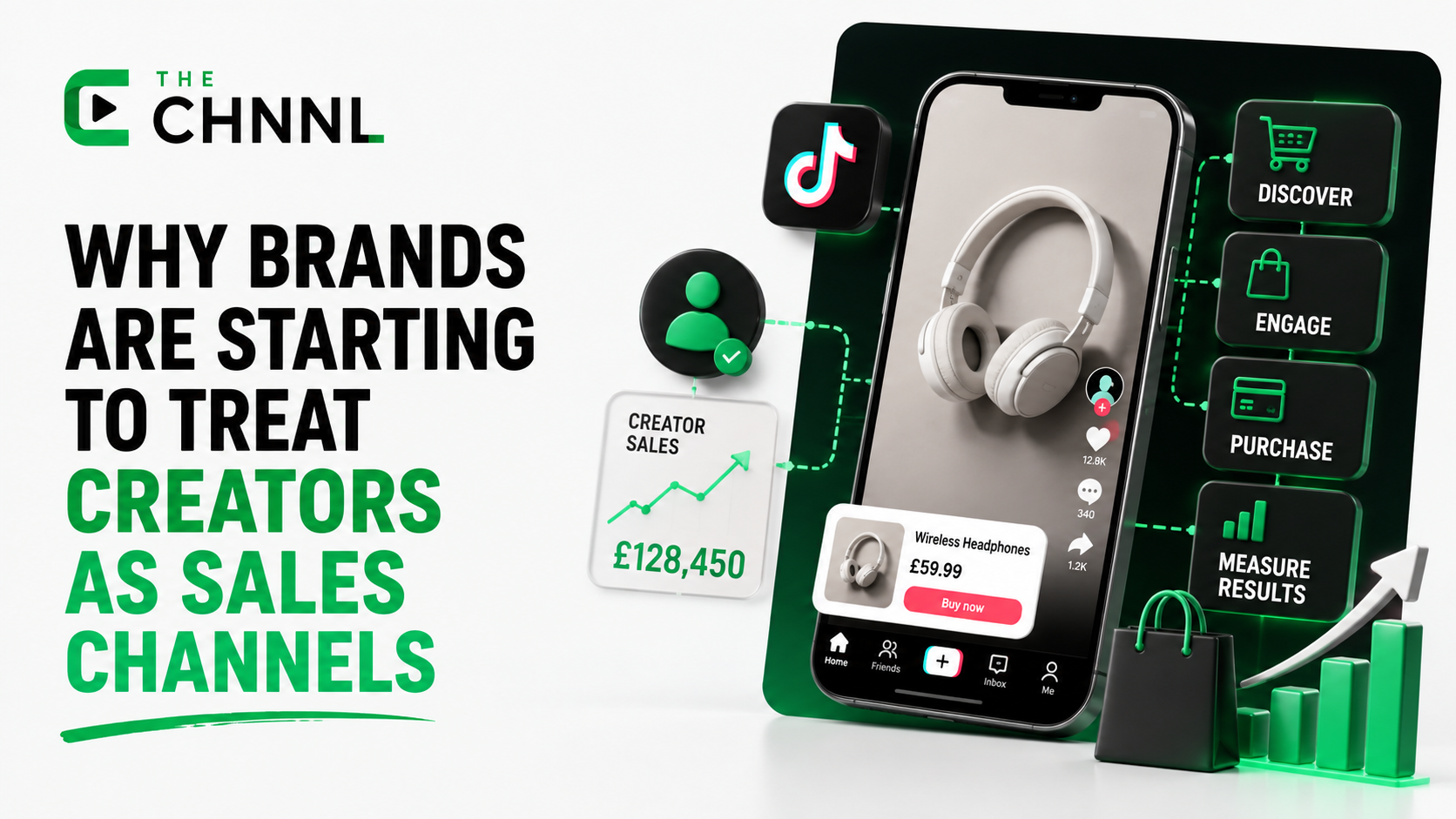
Why brands are starting to treat creators as sales channels
Creators are moving closer to the transaction, giving brands something more powerful than attention alone: a new way to sell products.